Rack System · Houston Area
Pushback Rack for H-Town Warehouses
Cart-based LIFO storage with lanes 2 to 6 loads deep, fed by gravity and served from one aisle by ordinary counterbalance trucks.
Pushback Rack delivered and put up from Fort Bend County to Galveston Bay. Asking for a price costs nothing.
The basics
How Pushback Rack earns its floor space
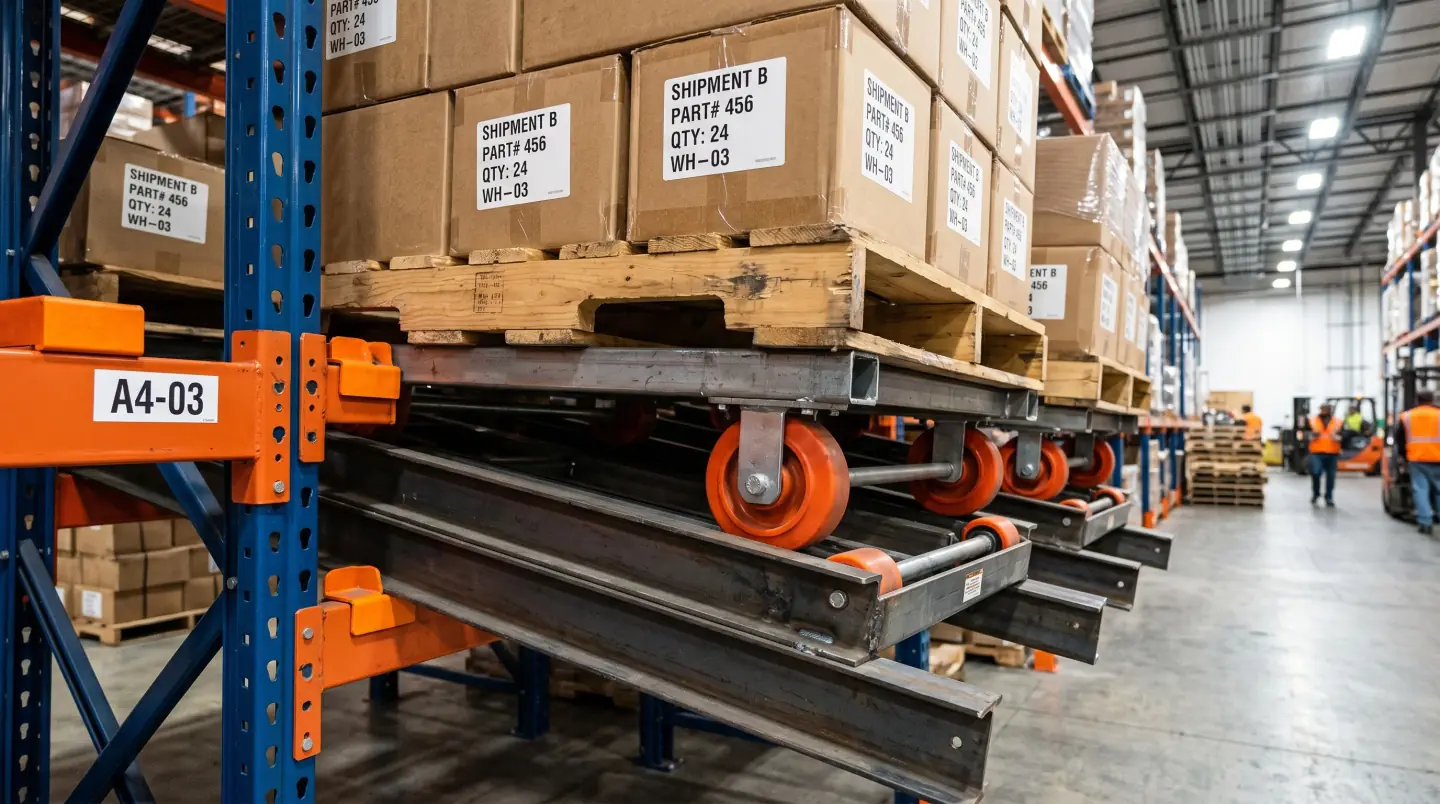
In a pushback lane, each new pallet shoves the one before it rearward on a set of nested carts that ride sloped rails. Pull the front load and the next one coasts forward to the aisle on its own. Lanes hold 2 to 6 pallets, which lands you close to twice the openings of selective rack on the same floor, and the lift truck never drives inside the structure the way it does in drive-in. That combination makes pushback a natural fit for Houston-area freezers and coolers, beverage houses and consumer-goods distributors whose loads stack up by SKU and can rotate last-in, first-out. H-Town Pallet Racking lays out each lane, supplies the carts and rails, and installs the system to the building code your city has adopted and RMI ANSI MH16.1-2023, with stamped drawings when your permit calls for them.
- Close to twice the pallet openings of selective on the same floor
- Trucks stay out of the rack, removing the most common source of frame damage
- Works with the counterbalance trucks you already own
- Quicker cycles than drive-in because the truck never pulls into a bay
Built in
Features that matter
- Lanes built 2, 3, 4, 5 or 6 loads deep
- Painted nesting carts on polyurethane wheels
- Sloped rails that feed by gravity, with nothing to plug in
- Sized for 40 by 48 inch pallets or your own footprint
- Choice of teardrop or structural channel frames
- Designed to the adopted local building code and RMI ANSI MH16.1-2023
- Stamped drawings available for Houston-area permit submittals
By the numbers
Pushback Rack: specs
Typical specs
Sloped rails, stacked carts
Every lane runs on steel rails tilted a few percent toward the aisle. Wheeled carts sit one inside another, one cart for each load behind the front position.
Loading pushes the stack
The truck sets a pallet on the uppermost cart. Setting the next pallet nudges the first one back, and each cart tucks under the one above it.
Picking lets it roll
Take the front load away and whatever sits behind it rolls down to the aisle face. The slope does the work, with no motors or controls.
Good fit or not
Does it suit your building?
It makes sense when
- Loads of one SKU arrive and ship in groups of 2 to 6 and LIFO does no harm
- Your cooler or freezer is paying to chill aisle space that could hold product
- Repair bills from trucks striking uprights inside the rack keep showing up
- You want close to double the openings of selective without buying new trucks
- Drive-in density appeals but its slower in-and-out cycles do not
Look elsewhere when
- Dated stock must leave oldest-first; pallet flow handles that
- Nearly every opening holds a different SKU; selective serves you better
- Lanes need to run deeper than 6 loads; look at drive-in or pallet flow
- You already run reach trucks and only care about cost per opening; drive-in is cheaper
Where it shows up
Who uses it around H-Town
Seafood and grocery cold storage: Texas City, League City, Galveston
Coolers and freezers around Galveston Bay handle cases of one product that arrive together. Pushback packs those lanes deep while keeping lift trucks in the aisle, so less refrigerated space goes to driving room.
Beverage and snack distribution: Sugar Land, Missouri City
Fort Bend distributors stage full pallets of the same drink or snack line. Grouping a SKU per lane and rotating LIFO suits product that turns quickly.
Consumer goods DCs on the Grand Parkway: Richmond, Fulshear
Newer distribution buildings west of Sugar Land use pushback for bulk reserve behind the pick area, where one SKU fills the whole lane.
Packaged resin and plastics: Mont Belvieu, Channelview
Bagged resin and film tend to ship in large single-grade lots. Pushback trims the floor footprint, though stored plastics count as a high-hazard commodity, so sprinkler design has to be settled before the layout is final.
Port-linked import storage: Freeport, Alvin
Containers unloaded near Port Freeport often bring deep stacks of a single item. Pushback keeps those lots together without committing the building to a reach-truck fleet.
Asked and answered
Questions about Pushback Rack
1 How deep can a pushback lane be built?
Two to six loads is the normal range. Deeper lanes can be designed, but the carts have to nest cleanly and pallet quality varies, so the chance of a hang-up rises past six. Three and four deep is where most buyers settle because it balances storage gain against day-to-day reliability.
2 How heavy a pallet can pushback carry?
Typical carts are rated near 3,000 lb per position, and structural systems reach about 4,000 lb. Food, drink and packaged goods fall well inside that. Very dense loads like coil, castings or some building materials usually push you toward a structural design or a different rack style.
3 Can two SKUs share a pushback lane?
They can, but the lane only gives up its newest load first, so anything at the rear stays trapped until the loads ahead of it ship. For product with tight code dates or lot rules, pallet flow is the better choice because it rotates oldest-first.
4 Do I need special lift trucks for pushback?
No. Because the truck only sets and removes loads at the aisle face, ordinary counterbalance trucks do the job. That is one of the main reasons buyers pick pushback over drive-in, which usually works best with reach or narrow-aisle equipment.
5 Pushback or drive-in: which should I pick?
Both rotate LIFO and both add density. Drive-in goes deeper and costs less per opening, but trucks drive into the structure, which raises the odds of damaged uprights. Pushback keeps trucks outside the rack and runs with counterbalance equipment. If your fleet is not already reach trucks and you want to hold down repair spending, pushback usually wins.
6 What does pushback cost compared with selective?
Per opening, pushback materials typically run two to three times selective, and installation takes longer because of the rails and carts. What you get back is 2 to 6 loads in each lane, so the price per pallet stored often comes out well below what the per-opening figure suggests. We quote after reviewing your SKU counts and lane needs.
7 Where does the payback on pushback come from?
Rarely from the steel itself. The return usually shows up as an expansion or second building you no longer need, fewer aisles to light and cool, and in cold rooms a smaller refrigerated volume. If more space is already on your list, pushback often pays for itself well before a build-out would.
Our fifteen towns
Pushback Rack around H-Town
We handle pushback rack in fifteen towns around Houston, spread across Fort Bend, Brazoria, Montgomery, Galveston, Chambers and Harris counties. Each town page covers who reviews permits there, the usual building heights and the kinds of businesses we rack.
- Sugar Land, TX Pushback Rack
- Missouri City, TX Pushback Rack
- Richmond, TX Pushback Rack
- Fulshear, TX Pushback Rack
- Alvin, TX Pushback Rack
- Freeport, TX Pushback Rack
- The Woodlands, TX Pushback Rack
- Magnolia, TX Pushback Rack
- Channelview, TX Pushback Rack
- Mont Belvieu, TX Pushback Rack
- League City, TX Pushback Rack
- Friendswood, TX Pushback Rack
- Webster, TX Pushback Rack
- Texas City, TX Pushback Rack
- Galveston, TX Pushback Rack